Penci.ly
A visual workspace for organizing ideas, research, and creative projects with notes, media, tasks, and connected boards on an infinite canvas.
Overview
- Role
- Founder / Developer
- Status
- In Development
- Technology
- Next.jsReactTypeScriptConvexClerkCloudinaryTailwind CSSshadcn/ui
- Year
- 2025
- Release stage
- Pre-alpha
The Project
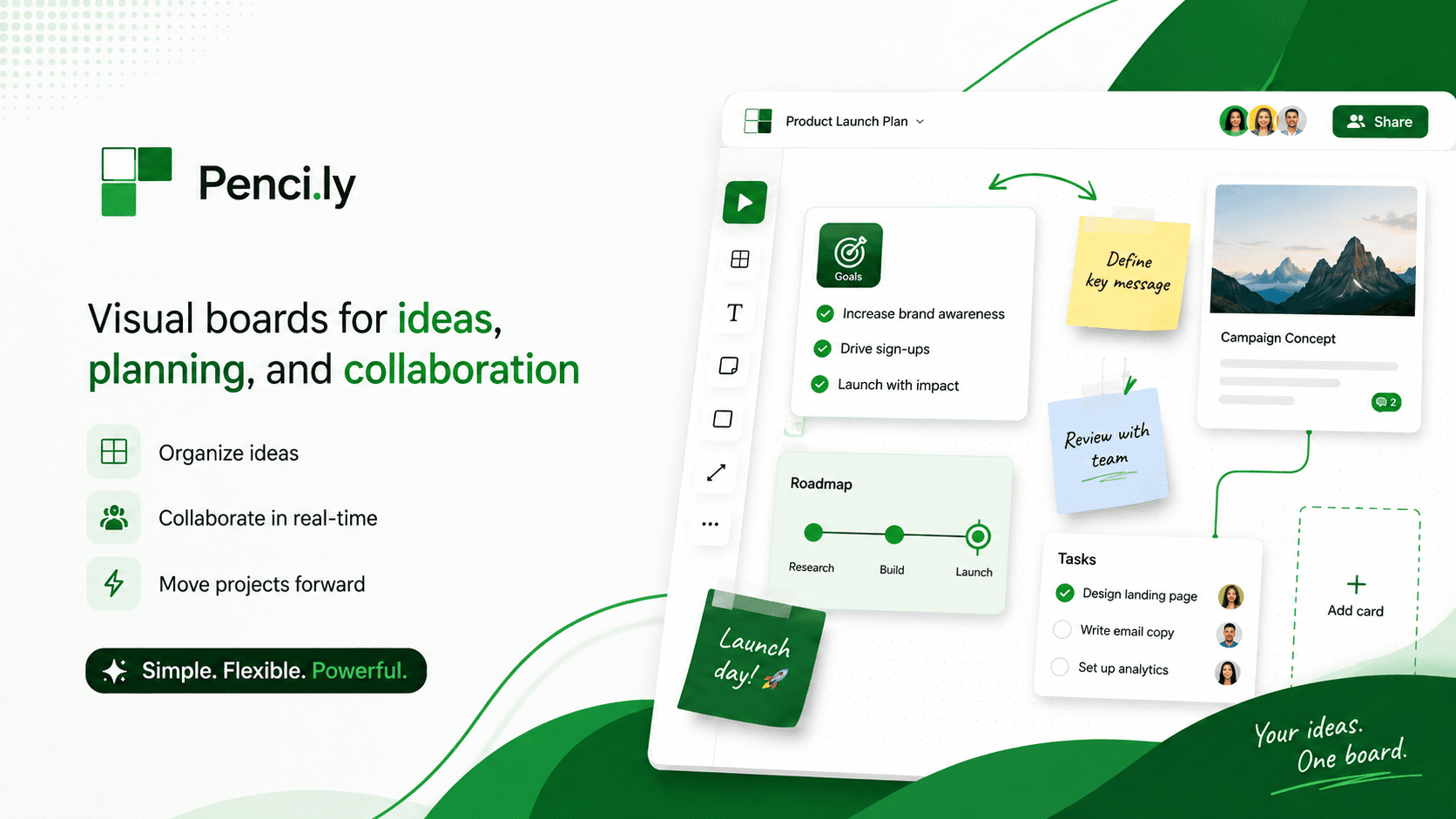
Penci.ly is a visual workspace for bringing the different parts of a project into one place. Notes, images, videos, links, and tasks sit together on an infinite canvas, where their position and connections help explain how they relate.
I am developing Penci.ly as an independent software product, bringing together product planning, interface design, and full-stack development. The aim is to make it easier to move from a collection of ideas to a project with a visible structure.
The Problem
At the beginning of a project, useful material rarely arrives in a neat order. A reference image suggests a direction, a short note becomes a larger idea, and a saved link raises a question worth investigating. Across documents, browser tabs, and task lists, those connections are easy to lose.
Penci.ly gives that material a shared visual space. Ideas can be collected and rearranged before their final structure is clear, while cards, connections, and nested boards provide more organization as the project develops.
How It Works
The board is the main workspace. Users can place rich text, media, to-do lists, tables, callouts, links, and colour swatches directly on the canvas or group them inside titled cards. Elements can move between cards and the wider board as the layout changes.
Connections make relationships visible, whether they represent a sequence of tasks, a branching story, or a link between research themes. Nested boards provide room to explore a topic in more detail while keeping the larger project organized.
Collaboration is built into the workspace. Users can invite others with viewer or editor permissions, see who is present, and follow changes in real time. PDF export provides a snapshot of the board for sharing outside the application.
What It Can Be Used For
For students and researchers, a board can bring source links, reading notes, questions, and emerging themes into the same view. For content creators, it can hold a brief, visual references, a storyboard, and the tasks needed to turn an idea into a finished piece.
Game developers and writers can map characters, locations, mechanics, and branching narratives. Product and design teams can collect references, compare directions, and organize requirements. These uses share the same underlying need: to see the material and the relationships between its parts.
My Role
As founder and developer, my work spans the product concept, the interface, and the systems behind it. This includes shaping the board experience, developing the application and its backend, and building the public website that explains the product.
The project also involves product communication and business planning. I have worked on use-case pages for different audiences and the subscription model behind the service, connecting how the product is built with how it is presented and sustained.
Design and Development
The interface centres on a full-screen board with floating tools and a dotted canvas. Cards provide structure within the open space, while alignment guides and snapping help users keep a board readable as it grows. Light and dark board themes let the workspace adapt to the material being organized.
A significant part of development has focused on the behaviour of the editor across mouse, touch, and stylus input. Moving an item, panning the board, resizing a card, and editing text need distinct, predictable interactions, especially when several gestures share a small screen.
Penci.ly is built with Next.js, React, and TypeScript. Convex handles application data and real-time updates, Clerk provides authentication, and Cloudinary handles media storage. Tailwind CSS and shadcn/ui support the interface.
Current Stage
Penci.ly is in pre-alpha and remains under active development. The project already brings together visual board editing, nested organization, collaboration, and PDF export, with ongoing work on interaction quality and performance.
It is a continuing product-development project, combining the technical work of building an application with the design and communication work needed to make its purpose clear.